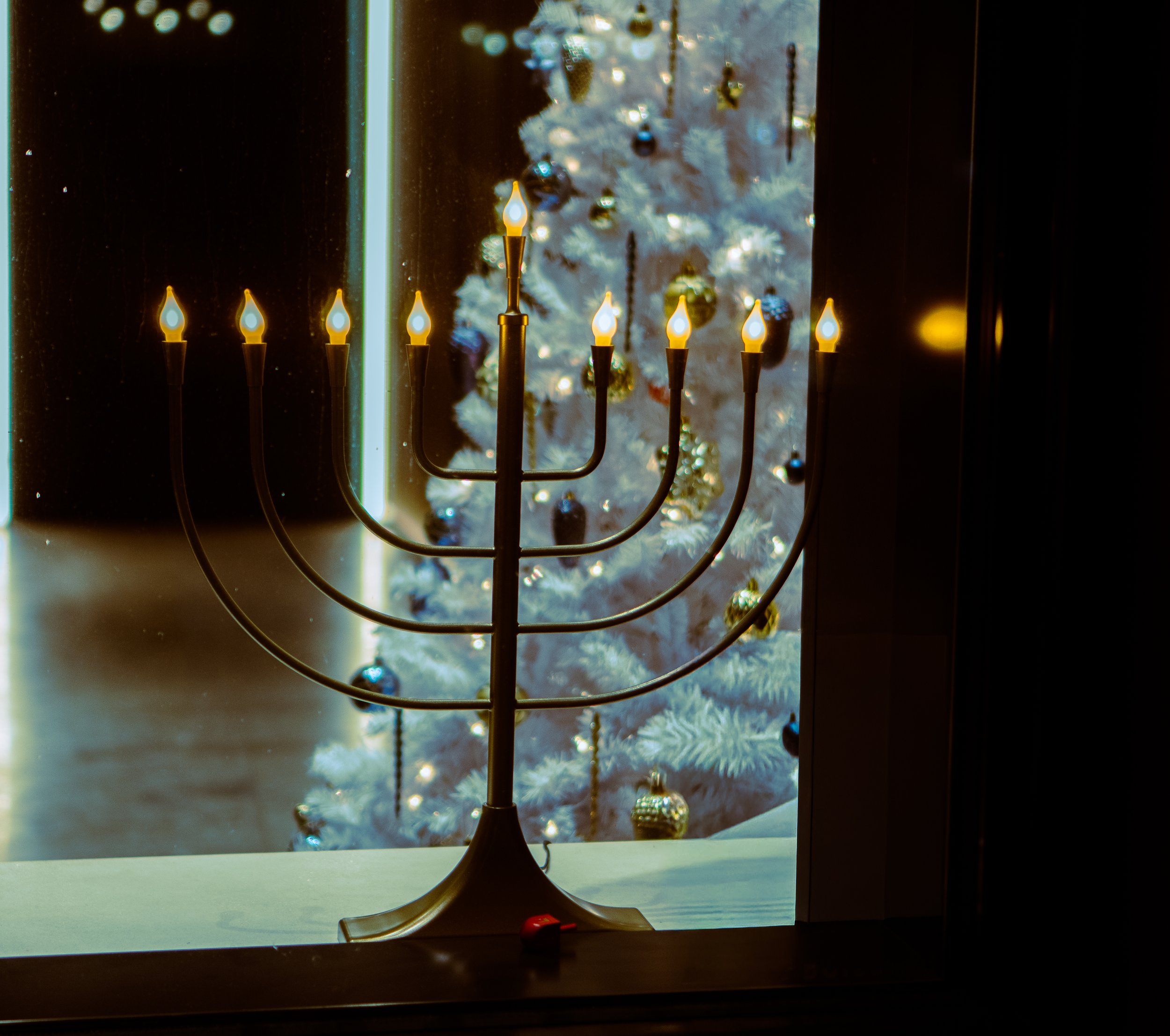
Menorah: A Symbol of Resilience across Oceans and Eras
On a warm summer evening in New York City, I found myself walking down Broadway toward the legendary Strand Book Store. As a book collector, bookstores have always been my sanctuaries. Before I was forced into exile in 2021 for my active role in the Burmese pro-democracy movement, my small apartment in Rangoon (Yangon) was defined by my personal library. When the military junta seized power, ending my life as I knew it, I made the painful but necessary choice to donate every single one of those books to grassroots organizations fighting on the front lines for democracy and self-determination. In New York, the smell of old paper is the closest thing I have to home.Deep in the basement of the Strand, I gravitated toward a quiet corner housing books on Judaism and Jewish history. I pulled a book titled "Judeophobia" by Peter Schafer from the shelf. For hours, standing in that subterranean sanctuary, I turned its pages. I learned of the ancient, structural roots of bigotry and oppression aimed at the Jewish people—prejudices that flourished in ancient Greece and Egypt long before the rise of the Roman Empire, culminating in centuries of persecution, pogroms, and genocide. I ended up leaving the store with eight books on Jewish history tucked under my arm.On my way back to the subway station, my mind heavy with the weight of the history I had just read, I stopped in front of a window display. Inside was a Menorah, its golden branches casting a calm, defiant glow against the dark street.Observing that Menorah, I felt an overwhelming sense of solitude, calmness, and hope.As someone with an anthropological and political worldview rather than a religious one, I do not approach Jewish history through the lens of scripture or creationism. Instead, I see a profound, secular masterclass in human endurance. The Menorah did not just represent a religious ritual to me; it stood as an enduring symbol of a people’s refusal to be erased. It was a testament to the survival of identity against the darkest forces of human history.As I stood there looking at the light in the window, my thoughts drifted back to my own homeland, and to my own people's struggle against Burmese chauvinism.The Erased Kingdom of Arakan
I am ethnically Arakanese despite my upbringing in Rangoon of Burma. My homeland lies along the western coastal region of Burma, separated from the central plains by the rugged Arakan Mountains. Today, central power in Burma is dominated by the majority Bama (Burman) ethnic group, but Arakan was once a proud, independent, and fiercely multicultural kingdom.In our golden era of Arakan, Buddhists and Muslims lived hand-in-hand. We had our own sovereign political entity, spoke our own language, minted our own currency, and cultivated a rich, diverse society completely distinct from central Burma. That independent sovereignty was shattered in 1784 when the Burmese kingdom invaded, annexed Arakan, and laid waste to our institutions. We have been fighting to reclaim our identity ever since.In modern Burma, systematic Burmese chauvinism has sought to grind the Arakanese spirit into dust. The state-sponsored narrative seeks to erase us. We are forbidden from using our native language in daily administration, barred from learning our true history in schools (where only central Bama history is taught), and systematically denied the right to advocate for the self-determination of Arakan.The prejudice we face is not merely political; it is deeply cultural and social. In Burma, there is a pervasive, dehumanizing saying: "If you see a venomous snake and an Arakanese, kill the Arakanese first." This proverb lays bare the profound bigotry embedded in central society—a prejudice that paints an entire ethnic group as more treacherous than a deadly predator.Yet, like the Jewish people whose history I read in the basement of the Strand, we have refused to let the darkness swallow us.A Three-Generation Legacy of Resistance
Hope is not a passive emotion; it is an active inheritance. In my family, resistance is a flame that has been passed down through three successive generations.My late paternal grandfather stood firmly against the early roots of dictatorship and central chauvinism. My late father followed in his footsteps, refusing to bow to the military junta, a defiance for which he was rewarded with brutal confinement and years of imprisonment.When my turn came as a college student, I took up the mantle. I joined the pro-democracy movement, bearing the double burden of fighting a military dictatorship while weathering the racial hatred directed at me as an Arakanese activist. Ultimately, my resistance cost me my homeland, forcing me to flee into exile in 2021.But as I stood on that New York street looking at the Menorah, I realized something vital. They can confiscate our libraries. They can imprison our fathers. They can exile us from our native soil. But they cannot extinguish the hope that fuels our resistance.The Menorah reminds us that light does not depend on the absence of darkness; it is defined by its defiance of it. Like my grandfather and my father before me, I carry that light forward. The struggle for Arakanese self-determination, for a world free of chauvinism and tyranny, continues.We will keep the candles burning.