

The Kiss
The air inside the transit hubs of New York City is usually thick with anxiety, exhaust, and the frantic rhythm of people rushing to be elsewhere. Yet, it is precisely in these high-velocity spaces—like the underbelly of the 42nd Street station—where the universe occasionally staging-directs moments of absolute stillness.I had seen him before. He is a familiar specter in the city’s concrete theater: a street performer who dances with a lady-like skeletal doll, coaxing smiles and spare change from weary commuters who find brief joy in his macabre, beautiful waltz. He animates the inanimate, spinning her through the crowd as if they were in a grand ballroom rather than a tiled subway corridor.But on this particular day, the dance stopped.Through my lens, the rush of the crowd dissolved. The harsh fluorescent glow of the station softened into a warm, backlit halo. In a single, suspended breath, he closed his eyes, leaned forward, and kissed the lips of the doll.From a purely biochemical standpoint, science tells us that a kiss is a transactional sequence. It is the physical catalyst for the release of oxytocin—an amino-acid-based peptide hormone synthesized in our hypothalamus that fosters trust and bonding. It is a biological hand-shake, a neurological alignment of survival and reproduction.But looking at this frame, the reductionist view of science crumbles. The kiss escapes the cage of its chemical formula. It becomes something entirely undefined—and perhaps, fundamentally undefinable.Think of the taxonomy of this single gesture.Parents kiss the soft foreheads of their children, a declaration of instinctual protection and pure, unasking love. Lovers kiss in dark corners, their mouths tracing a fierce, magnetic attachment. Spouses kiss on altars and in kitchens, sealing a legal, historical, and emotional covenant. Strangers kiss in dim-lit pubs, fueled by a sudden, electric flash of chemistry and shared words. Colleagues exchange polite kisses on the cheek; friends kiss to say "I see you, you are safe with me". Sometimes, people kiss simply because the gravity of a moment pulls them together for no logical reason at all.Here, he was kissing his doll as part of an act.Yet, there was nothing hollow about it. In that split second, the kiss ceased to be a prop in a performance and became a mirror. It revealed something profound about the architecture of human relationships. A kiss is not merely a symptom of love or friendship; it is a unique, sovereign dimension of human connection. It exists in the quiet spaces between classifications—not quite love, not quite parenthood, not friendship, nor a modern "situationship."It is a silent dialogue. When lips meet, the rest of the world is locked out. Only the kisser and the kissed hold the key to what is passing between them in that silent, inexpressible space. On a crowded afternoon at 42nd Street, a man and his skeletal companion reminded me that the deepest parts of our humanity are those we cannot put into words.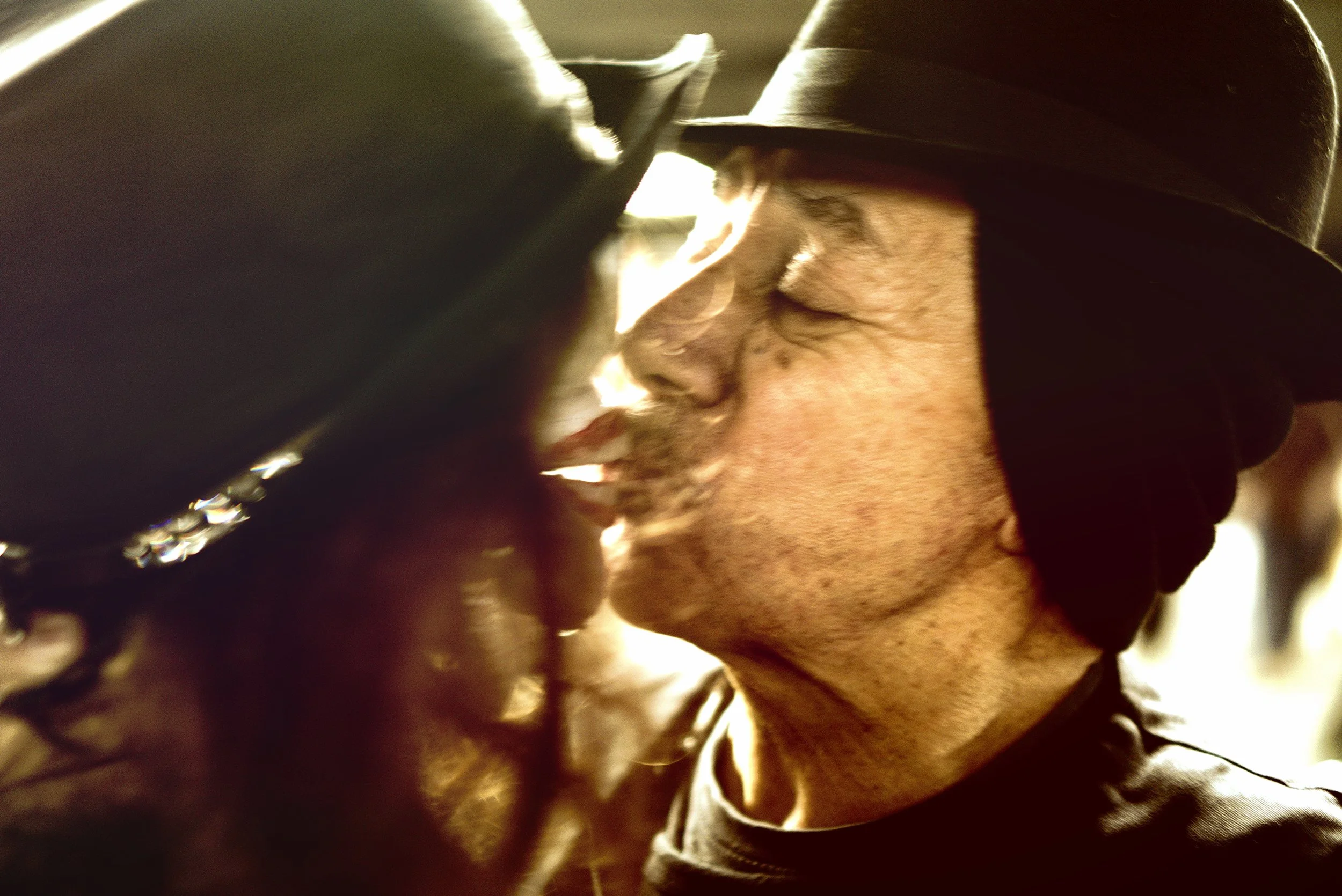
The Kiss